Seat
dedication in Leslie's boyhood village, Isleham, Cambridgeshire, 9
June 2012
Service of Celebration, 26 May 2011
Obituary
in the Daily Telegraph, Friday 13th May 2011
Leslie Audus the scientist
Fiona Pushman, Leslie's daughter, writes: 'Isleham was not
only where Leslie was born and raised, but it remained a place that
mattered to him throughout his long life. So the family wanted to have
something permanent to commemorate this lasting link.
On one visit when Leslie walked around the village with
Chris and me, we rested for a while on a memorial bench. This seemed so
suitable, in keeping with the village and we were pleased that the
Parish Council have approved our request for a similar bench in his
memory.
Therefore, on 9 June 2012, Leslie’s ashes will return to Isleham. At
11:15 am a bench will be dedicated to his memory at the top of Pound
Lane (opposite The Griffin) and at 11:45 his ashes will be
interred in the Isleham Cemetery .
There is also an area (just under an acre) of Priory Wood
at Burwell dedicated to his memory, but the Woodland Trust site does not
allow for any actual dedication plaque so is only known to those who
know!'
We are grateful to Fred Eden, a wartime schoolboy at Soham
Grammar School, for attending on behalf of the Soham Grammarians and for
these photos of the occasion.
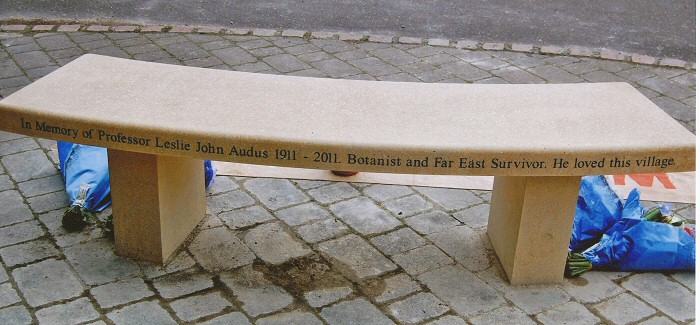
The seat is inscribed
In Memory of Professor Leslie John Audus 1911-2011. Botanist and Far
East Survivor. He loved this village.
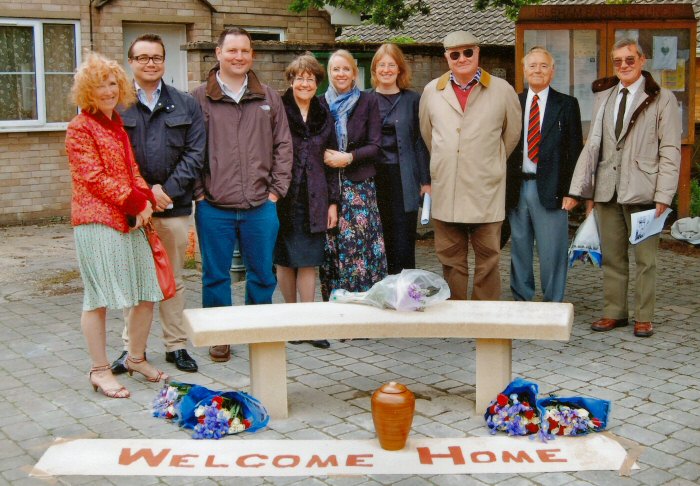
Leslie's daughter Fiona (4th on left) and members of Leslie's family at
the seat.
The Welcome Home banner was put up by Leslie's mother for the day he
returned from captivity in the Far East.
Fred Eden SG44 is the one wearing the Soham Grammarians tie.
Leslie Audus died aged 99 on 5th May
2011 and was cremated on Thursday 26th May 2011. The service of
thanksgiving to celebrate his life was held at Basingstoke
Crematorium, followed by a buffet lunch at Bolton Arms Old Basing.
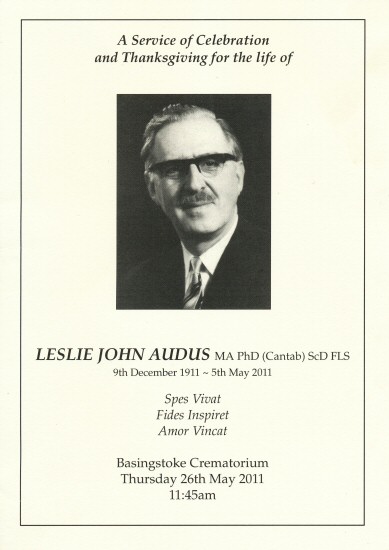
A Service of
Celebration
and Thanksgiving for the life of
LESLIE JOHN AUDUS
MA PhD (Cantab) ScD FLS
9th December 1911 - 5th May 2011
Spes Vivat
Fides Inspiret
Amor Vincat
Basingstoke Crematorium
Thursday 26th May 2011
11:45am
|
 |
Order of Service
Entry Music
Mahler - 5th Symphony - Adagietto
Welcome
Jeremy Caddy - Funeral Celebrant
Introduction
Hymn
Abide with me; fast falls the eventide
Tribute
Early Life [to be added]
Music
Linden Lea
Soloist Joan Warren with Harp accompanist Judith Philip
Tribute
POW Years (1942 - 1945)
Followed by music
Brahms Piano Concerto B flat Major - 4th Movement
Tribute
FEPOW by Meg Parkes
Followed by FEPOW Prayer
The following tribute, written by RAF Medical Officer
Richard Philps at the start of his memoir, Prisoner Doctor
was published in 1996:
“The men who survived Haruku and subsequent camps have
reason to be extremely grateful to Leslie J Audus, Professor Emeritus
of Botany at London University. Professor Audus was with us as a
prisoner, having joined the Royal Air Force as a scientist and become
a Radar (then called Radiolocation) Officer.
During our first critical time at Haruku, with deaths
from beriberi mounting and blindness from Vitamin B deficiency on the
increase, he, at first single-handedly, and later with a Dutch
botanist, Dr (now Professor) JG ten Houten, devised a method of
producing yeast, an abundant source of Vitamin B.
This was against almost impossible odds and with the
most primitive equipment, but it was so successful that the onset of
blindness was halted in those already affected, no new cases occurred,
and other changes due to Vitamin B deficiency began to improve – a
remarkable feat of biological manipulation.”
I would add to Dr Philps’ words that those of us with an
interest in FEPOW, that is Far East Prisoner Of War, history, be it
academic or family-inspired, also owe Leslie John Audus a huge debt of
gratitude.
Not only did his expertise and practical ability save
countless lives between 1942 and 1945, but by committing his
experiences to print as he later did, he ensured that future
generations would also gain a better understanding of the
circumstances of their survival.
After their liberation and repatriation during the
autumn of 1945, most FEPOW found it very difficult to share their
experiences with others. They were not encouraged to do so; some men
never did. As a consequence, even today their part in World War Two
history is still relatively little known.
The public perception of Far East captivity is generally
centred around the building of the railway through the jungles of
Thailand and Burma. But thanks to Leslie’s decision to publish a paper
in 1946 entitled, Biology Behind Barbed Wire, in the
scientific journal Discovery, the facts were set out while
they were still clear in his mind.
This article became the basis for a book about Far East
captivity in the Moluccas (commonly known as the Spice Islands),
published initially by Dutch prisoners of war. Years later this book
was translated into English by Leslie and became Spice Islands
Slaves. Now we could learn about the equally appalling
circumstances endured by over 2,000 British FEPOW who were shipped
from Java to build airfields on the Spice Islands in April 1943 –
truly a voyage into Hades.
I first met Leslie in 2003 when I bought his book
through the Java FEPOW 1942 Club. He was a
long-standing and valued member of the Club (and also the London
FEPOW Club). Indeed, some of the other Java Club FEPOWs had
directly benefitted from his ingenuity and skill. I had just recently
joined the Java Club and was attending the annual meeting in
Stratford-upon-Avon. My interest in this history stemmed from my
father’s FEPOW captivity in both Java and Japan (though to my
knowledge, the two never met).
I subsequently had the great good fortune to visit
Leslie on two separate occasions at home in his Earl’s Court flat,
where I listened to his vivid recollections of those days. He showed
me some of his vast collection of drawings and memorabilia, recorded,
hidden and eventually brought home.
What a treasure trove!
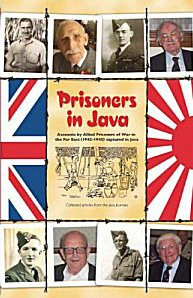
In 2006, Leslie wrote a Foreword for the Java FEPOW
Club’s book, Prisoner in Java, a compilation of articles
extracted from twenty-two years of the Club’s quarterly newsletter, The
Java Journals. The Club not only looks after the few remaining
FEPOW veterans, but also their widows. Both the book, and the ongoing
work of the Club, honour all these courageous men and women.
My own interest has grown into academic study and I am
based at the Liverpool School of Tropical Medicine. During the
research for my dissertation, I came across an interview that Leslie
gave, in August 1986, aged 75, to Dr Charles Roland from McMaster
University in Ontario. I quote:
“… mental attitude played such a vital part in
survival. This is why I think
I’m so lucky in that I had something to interest me. I had this
yeast-stuff to make…”
Something of an understatement, I would say.
In January 2009, Leslie agreed to give me an interview
about his long-term perspective of those years in captivity, as part
of the Liverpool Tropical School’s FEPOW oral history study. It was
such a privilege to listen to and record his recollections.
On behalf of all the members of the Java FEPOW 1942 Club
- FEPOW history researchers everywhere - and from me: Thank You,
Leslie.
THE FEPOW PRAYER
by
FEPOWs Cpl Arthur E Ogden and Victor Merrett
And we that are left grow old with the years
Remembering the heartache, the pain and the tears,
Hoping and praying that never again
Man will sink to such sorrow and shame.
The price that was paid we will always remember
Every day, every month, not just in November,
We Shall Remember Them.
Tribute
Academic Years (1948 - 1979) by Professor WG Chaloner
[items in italics were in Prof Chaloner's draft
but omitted on the day as they overlapped with what Leslie's daughter
Fiona covered]
Poem
'All is Well' by Canon Henry Scott Holland
Read by Ian Philip
Family Memories
Grandsons [to be added]
Quiet and Reflective time
The Ash Grove - Harpist Judith Philip
The Lords Prayer
Our Father, who art in Heaven,
Hallowed be Thy name;
Thy kingdom come;
Thy will be done;
on earth, as it is in Heaven.
Give us this day our daily bread,
and forgive us our trespasses,
As we forgive those who trespass against us.
And lead us not into temptation;
But deliver us from evil.
For Thine is the Kingdom,
The Power, and the Glory,
For ever and ever Amen.
The Committal
Final Words
Music
Lark Ascending by Vaughan Williams
Played by Nicola Benedetti
The family would like to invite everybody
to join them after the service at
The Bolton Arms, Old Basing, RG24 7DA
for a Carvery Lunch.

Donations in memory of Leslie
if desired in aid of
'The Woodland Trust' or 'The Java FEPOW Club'
may be left as you leave the chapel or sent c/o
Co-operative Funeralcare
1 Buckland Avenue
Basingstoke
Hampshire
RG22 6JW
The family are grateful for all the comfort and support
that friends have given to Leslie over the years.
Leslie John Audus, an only child, was born on December 9 1911 at
Isleham in the fens of Cambridgeshire, a part of the country for which
he retained a deep affection for the rest of his life. Educated at Soham
Grammar School, in 1929 he won a scholarship to Downing College,
Cambridge. After completing his degree he carried out postgraduate work
until 1935.
From Cambridge he progressed to University College, Cardiff, where he
combined further research in plant physiology with teaching across a
broad spectrum of plant science. Having joined the RAFVR in 1940, he
trained in radar and in 1941 was posted to Malaya as a flight
lieutenant.
In the brief interlude before fighting hit Malaya later that year,
Audus used his free time to explore the rainforest in Johore with John
Corner (later a renowned Cambridge botanist), who was then assistant
director of the botanical gardens there.
Audus made himself popular by bringing with him a turntable,
loudspeakers and a collection of records. On the fall of Singapore, the
discs accompanied him as he escaped with his unit by ship to Jakarta. He
even managed to hang on to them after being captured there by the
Japanese, leaving them behind (with his initials scratched into the
centre of each record) only after being sent to a camp on Haruku island.
Audus’s book Spice Island Slaves (1996) records the horrors
of this time. Prisoners were forced to work in blinding sunlight to
build an airstrip from coral. As well as suffering regular beatings,
they were badly afflicted by beriberi and malnutrition-induced
conditions which affected their eyesight. Knowing of Audus’s expertise,
senior captive officers asked him to produce yeast to supply vitamins
that were missing from the men’s wretched diet.
Under conditions of extraordinary hardship, and with makeshift
equipment, Audus had first produced yeast – with the help of Dutch
fellow prisoners – at Jaarmarkt camp at Surabaya on Java. But when
transferred to Haruku he faced a problem: maize grain, which had
previously been used as a raw ingredient in the process, was not
available.
Instead he isolated a mould fungus that, in addition to producing the
needed vitamins, allowed him to manufacture an easily digestible protein
by fermenting soya beans. These supplements, together with the building
of a sea latrine that halted an outbreak of dysentery, helped reduce
prisoner deaths from 334 in five months to just 52 in the last nine
months before liberation.
On August 1 1945 Audus commanded the last party of six men out of the
camp. Ironically, however, when he was taken to hospital it was
discovered that he himself had already suffered irreversible retinal
damage. Remarkably, he overcame this disability in his subsequent
distinguished botanical career.
After the war he returned to plant physiology as a scientific officer
with the Agricultural Research Council unit of soil metabolism at
University College, Cardiff, focusing particularly on the action of
phenoxyacetic acid herbicide. From there he moved to the Hildred Carlile
Chair of Botany at Bedford College, University of London, which he held
until retiring in 1979.
There were initial difficulties: the Botany department was in cramped,
temporary accommodation with little equipment. But in 1952 it moved into
the new Darwin Building, and Audus embarked on an investigation into the
nature and mechanism of plant “hormones” (or “growth regulators”, as
they are now generally known) in roots, so resurrecting an interest in
plant responses to gravity, a research theme which had been largely
neglected for some 30 years.
The following year he published Plant Growth Substances,
which went through two more expanded editions (1959 and 1972) and became
the standard text on the subject for many years.
In 1964 he edited The Biochemistry and Physiology of Herbicides,
which was still the main reference book on that subject when he retired.
From 1965 to 1974 he edited the Journal of Experimental Botany.
Audus’s research on plant growth regulators had an impact in the
applied aspects of plant physiology, particularly in forestry,
agriculture and horticulture. This led to numerous scientific visits
overseas, and he gave advanced courses in some 15 major universities in
the United States.
He was appointed visiting Professor of Botany at the University of
California, Berkeley, in 1958; at the University of Minnesota,
Minneapolis, in 1965; and was created a life member of the New York
Academy of Sciences in 1953. Unusually for that time, he lectured
extensively in the USSR and in Poland.
For all this, Audus never neglected his departmental or collegiate
commitments. He was a fine teacher, and active in student affairs, both
social and scientific. As head of department he was approachable and
kindly. But the strength of character and tenacity that had brought him
through the horrors of war meant that he did not flinch from expressing
his views forcefully against injustice or political expediency.
His own considerable technical skill as an experimentalist also
extended to his extramural interests. He enjoyed the construction and
restoration of furniture, and built his own short-wave radio equipment
at a time when it was the only medium that enabled him to maintain
contact with former wartime comrades and fellow scientists in remote
parts of the world.
It was one such fellow prisoner who, during Audus’s time in captivity,
had managed to preserve 36 of the records he had taken out to Malaya.
Audus heard the strains of Brahms’s Piano Concerto in B Flat Major
in Jakarta after being liberated and, pointing to his scratched
signature, declared that this record and the others were his own. He
kept them for the rest of his life.
Leslie Audus married, in 1938, Rowena Mabel Ferguson. She died in 1987,
and he is survived by two daughters.
[to be added from Leslie's unpublished biography]
Leslie John Audus was born on December 11th 1911 and was educated at
Soham Grammar School, leaving, it is thought, in 1929. He went up to
Downing College Cambridge where he was Exhibitioner, 1929–31. SGS
records show he gained a Part I, Class 1, in the Natural Sciences Tripos
and that he was appointed Frank Smart University Student in Botany, at
Cambridge, 1934–35. In Summer 1937 it was reported that he was a
lecturer at Cardiff University, and had proceeded MA (Cantab) and had
obtained his PhD. Dr Leslie J Audus and Dr Rowena M Ferguson married at
Sheffield in 1938, she died in 1987. They had two daughters.
| He was Lecturer in Botany,
University Coll., Cardiff, 1935–40. During WW2 he was a Flight
Lieutenant RAFVR, serving in the Technical Branch as a Radar
Officer, 1940–46. He was PoW of the Japanese 1942-45. SG
Spring 1943: Prisoner of War: F Bye (Egypt), LJ
Audus (Java). SG Autumn 1945: Following
POWs back in England: CF Tabeart (Singapore), LJ
Audus (Java), JR Cogbill (Hong Kong)
His skills as a botanist enabled him to "save lives and the
eyesight of many men" - see
below
|
 |
He was Scientific Officer at the Agricultural Research Council's Unit
of Soil Metabolism, Cardiff, 1946–47 and Monsanto Lecturer in Plant
Physiology, University College, Cardiff, 1948.
In the same year he was appointed Professor at Bedford College, London
University. The Botany Department at Bedford College had been destroyed
during the bombing of London, and the Departments of Botany and Zoology
were housed in the former mansion of a member of the gentry on the edge
of Regents Park. Professor Nielson-Jones retired and Professor
Leslie Audus was appointed in his place, and he started up
his well-known researches on the hormonal control of root growth,
geotropism, and other topics. He was Hildred Carlile Professor of
Botany, Bedford College, University of London, 1948–79.
He was Recorder, 1961–65, and President 1967–68, of Section K of the
British Association for the Advancement of Science: Visiting Professor
of Botany, University of California, Berkeley, 1958 and University of
Minnesota, Minneapolis, 1965.
He was Vice-President of the Linnean Society of London, 1959–60 and
made Honorary Fellow in 1995: Life Member of the New York Academy of
Sciences, 1961; Editor of the Journal of Experimental Botany,
1965–74.
Lesley Audus died on 5 May 2011.
Papers
by LJ Audus
from Death in the Spice Islands,
compiled by Amanda Johnston
http://www.cofepow.org.uk/pages/asia_haruku1.html
Heroes of Haruku There were many heroes in the Pelauw
camp in Haruku whose day-to-day acts of brotherhood and compassion
surely alleviated the suffering of their friends under these diabolical
circumstances. The doctors, amongst them Dr. Buning, Dr. Springer, Dr.
Philps and Dr. Bryan, saved many lives using the crudest of contrived
instruments and effecting what cures they could in the absence of
medicines or even vegetation to concoct alternative means of healing.
One of these heroes was not a doctor, but a botanist by training who
went on to become a Professor of Botany at London University some years
after the War (now an Emeritus Professor), and who was serving as a
radio officer in the RAF when taken prisoner: Leslie Audus
used his skills to manufacture yeast from 'next to nothing', providing
the very sick, and eventually all the men, with a source of vitamin B,
the absence of which in their scant diet was worsening their state of
malnutrition and causing beriberi and pellagra as well as optic
neurosis, the result of which could be irreversible blindness.
A good summary of his cultivation methods can be found in Dr. Richard
Philps' book, Prisoner Doctor as well as in his own definitive
work on the Moluccas drafts - Spice Island Slaves. Without a
doubt he saved many lives and the eyesight of many of the men by
developing his cultures, and they were most fortunate indeed that he was
in the Haruku draft where conditions were so appalling. He was only
permitted to continue with his yeast-making activities because one of
the by-products was alcohol, which was then commandeered by the Japanese
guards.
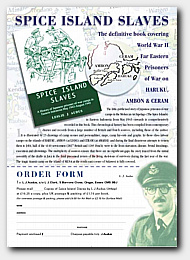
| Spice Island Slaves
by Leslie J Audus The little-publicised story of
Japanese prisoner-of-war camps in the Moluccan Archipelago
(The Spice Islands) In Eastern Indonesia from May 1943 onwards
is comprehensively recorded in this book. This chronological
history has been compiled from contemporary diaries and
records from a large number of British and Dutch sources,
including those of the author.
It is illustrated by 25 drawings of camp scenes and
personalities, maps, camp lay-outs and graphs. In those
slave-labour camps on the islands of HARUKU, AMBON (at
Liang) and CERAM (at Amahai) and during the final disastrous
attempts to return them to Java, half of the 4,110
servicemen (2,827 British and 1,283 Dutch) were to die from
starvation, disease, brutal thrashings, execution and
drownings.
The multiplicity of the sources ensure that there are no
significant gaps the story traced from from the initial
assembly of the drafts in Java to the final piecemeal return
of the living skeletons of survivors during the last year of
the war. The tragic transit camp on the island of MUNA at
the south-east corner of Sulawesi is fully covered.
|
 |
ORDER FORM/CONTACT: Leslie J. Audus, c/o Lesley J. Clark, 5 Barrons
Close, Ongar, Essex, CM5 9BJ
E-mail address: Lesley Clark - lesleyclarkuk@yahoo.co.uk
PRICE: £10.25 per copy, plus UK postage & packing of £1.70 per book
(for overseas postage & packing, please add £ 4.55 for Air Mail or £
2.15 for Surface Mail)
Audus, Leslie J, Spice Island Slaves,
UK repr. 1998: Essential reading for Haruku Island, Liang, Ambon, etc.
Interesting account of synthesising vital B vitamins from rice. Good
maps and illustrations. Straightforward writing for general reader.
From RAF boy apprentice to prisoner of the Japanese, by Amanda
Johnston (WW2 People's War, BBC)
"Later, in April 1943, large numbers of men were marshalled at Jaarmarkt
Camp in Sourabaya, Java. Eric was one of 2,070 sent on a draft to the
Moluccan or ‘Spice’ Island of Haruku. Docking at Ambon in early May
1943, just before his 23rd birthday, they arrived on the muddy shores in
the monsoon season to find that they were to build their huts from
bamboo and set up what meagre facilities they could. A full account of
this and the other Moluccan drafts is given in accurate and stark detail
in the excellent book, Spice Island Slaves by Prof.
Leslie Audus, but I will continue with the bare details here.
The British commanding officer requested permission from the Japanese
to build a latrine over the sea to avoid the spread of disease. The
refusal of this request meant that the overflowing latrines and the
generally cramped and foul conditions of the makeshift camp led to a
general outbreak of dysentery, which along with the other diseases from
which the men were suffering — malaria, beri beri and diphtheria to name
a few — along with the general state of malnutrition, saw to it that of
the 2,070 men who arrived on this draft, around one fifth died within
the first few months. On top of all this, we have yet to mention their
reason for being there. They were forced by the Japanese to hack an
airstrip out of the coral of the island in order to build an airstrip
(allegedly within range of Australia). The weakened state of the men
meant that, six months into the draft, there were only around 300 to 400
anywhere near “fit” enough to go on the working parties to the airstrip.
When they were eventually allowed to build the sea latrine some months
later, the dysentery epidemic was brought under greater control and the
death rate slowed down. The Japanese sergeant responsible for this
atrocity, Gunso Mori, was later held accountable for this and other war
crimes at the post-war Far East War Crimes Tribunal and was hanged in
Singapore in 1946, along with the camp commander, Lt. Col. Anami. It has
been estimated by Prof. Audus that sadly only 40% of
those sent to toil as slaves on Haruku would have returned to the shores
of England in 1945, and Eric was fortunate enough to be one of them."
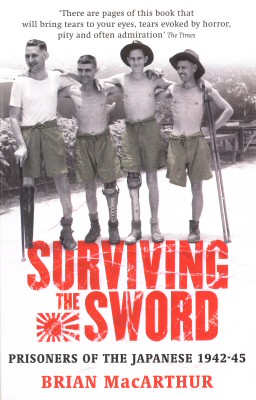
| Leslie Audus is
also referred to several times in Brian MacArthur's book - in
this link the author talks briefly about it Surviving
the Sword: Prisoners of the Japanese 1942-45
.
The following extracts are reproduced by kind permission of
the author:
The book is available in the UK - Amazon.
p266 - Entertainment
The prisoners' affection for their records was shown by the
example of Flt. Lt. Leslie Audus. When he
moved to his radar station on the Malayan mainland in 1941
he took with him an amplifier, turntable, a pick-up and
loudspeakers, as well as a collection of records. After
being captured in Java, the collection was driven into
captivity, but the Dutch provided a gramophone and recitals
were given for hundreds of prisoners. When Audus was sent to
Haruku the records were left behind, but he had scratched
his name with a sharp nail on the smooth surface between the
label and grooves on every one.
When he returned to Batavia in July 1945, he heard a
familiar sound - the scratchy strains of the Brahms Piano
Concerto in B Flat Major - and was able to claim the
record as his. Thirty-six records had survived in total, and
Audus still had them in 2004 in their original paper sleeves
- a tribute, as he says, to the loving care with which they
had been preserved by an emaciated young radar officer.
|
 |
p283-286 - Ingenuity
One of the most remarkable examples of ingenuity occurred in
1944 on the Spice Island of Haruku. The men were working in blinding
sunlight to build an airfield from coral, and optical neuritis was
causing partial and even complete blindness. (See Chapter 23 for a full
account of the horrors of Haruku.) Flt. Lt. Leslie Audus,
who had just emerged from hospital partially blind himself, was urged by
Flt. Lt. Dick Philps, one of the medical officers, to start producing
yeast to provide the vitamins that were missing from the men's diet.
Audus had performed the same function earlier in Jaarmarkt camp at
Surabaya on Java.
Two Dutch prisoners, Dr van Papenrecht (who had helped Audus in
Jaarmarkt, supplying him with raw materials) and Dr ten Houten (who had
used Audus's methods on Ceram), were asked to join him. Van Papenrecht
provided his microscope, haemocytometer and a supply of reagents for
testing for sugar, and allowed Audus and ten Houten to use his
`dispensary' for experimenting.
But there was a major problem to be solved. Maize grain had previously
been the raw material in the process. But on Haruku no maize was
available. Audus's thoughts turned to his preliminary experiments in
Surabaya on the use of mould enzymes to produce a nutrient medium from
steamed rice. Picking up where he had left off in Java, he soon isolated
a mould fungus that was extremely efficient in converting starch into
sugar. This mould turned out to be Rhizopus oryzae, the
species used in the production of tempeh kedelai.
Audus described how he finally succeeded:
Kedelai is the soya bean which we were sometimes given to eat
but long boiling did nothing to make it digestible in the stomach. Dr
Pieters, an Indonesian prisoner arriving with the Amahaiers [Dutch
prisoners who had been previously been held at Amahai on Ceram],
instructed me in the method the natives use to make it digestible by
growing a fungus on it producing tempeh kedelai, a cheese-like material
which was then fried in oil. It is an acquired taste but very
nutritious. After we had acquired the technique we regularly made the
product whenever the beans were provided. The prisoners undoubtedly
profited from this protein-rich product.
Then followed weeks of crude but intensive tests to determine the
growth conditions for the mould on steamed rice and the optimum
temperature for the subsequent killing of the mould with release of the
effective enzymes. In this, fate and my dormant optimism had played a
crucial part since I still had the thermometer I had made in the
Jaarmarkt. The optimum temperature for sugar production determined
thereby turned out to be 55 degrees C. Thus encouraged we turned our
attention to finding the source of the yeast and following that deciding
the final method of bulk production and the assembling and construction
of equipment for it.
Yeast was easily isolated from the surface skin of a ripe banana by
putting a small piece in some rice digest fortified with cane sugar. The
fermentation which followed yielded a healthy suspension of yeast cells.
Bulk production started about Christmastime. For the mass production of
the essential rice/fungus mixture we simply `stole' the tempeh
kedelai technique. Wooden trays, with sacking bottoms, were
filled with inch-thick layers of steamed rice inoculated with the tempeh
kedelai fungal spores and sandwiched between layers of large
leaves to keep them moist. The fungus was left to grow for 38 to 40
hours, when it had turned the rice layer into a grey, spore-covered
'blanket' which could be lifted entire from a tray. A small portion with
its spore content was retained, dried and powdered to provide inoculum
for subsequent trays.
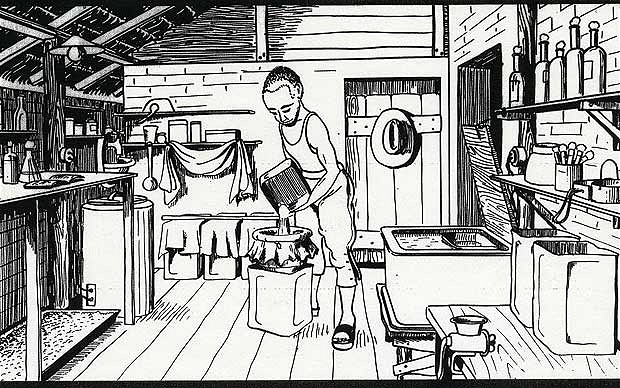
'Blankets' were mashed up with a small quantity of water in a large
wooden tub and the resultant `porridge' put in 25-litre earthenware
carboys originally containing soya sauce for the guards. To this
porridge was added boiling rice-washings to dilute it and bring the
temperature up to 60 degrees C. The carboys, closed with sterilised
wooden bungs, were incubated for 22 hours in 'hot-boxes', old tea chests
lined with layers of empty rice sacks, after which up to 80% of the
starch had been turned into sugar by the fungal enzymes. The digest,
strained through mosquito netting to remove fungal threads and rice cell
debris, was diluted with three times its volume of water and sterilised
by boiling. After cooling for 22 hours in large steel drums covered with
sterile sacks it was inoculated with the yeast culture. The supply of
that inoculum had been the province of Dr ten Houten who had maintained
it on a concentrated rice digest fortified with cane sugar.
The final drum fermentation lasted 48 hours and was virtually complete
by then, thanks to a massive inoculum. That milky suspension of yeast
cells was sterilized by heating to 70 degrees C for about 15 minutes in
a wajang [large iron wok], cooled and issued in 100 ml doses
to the hospital patients and, ultimately, to the whole camp. At that
time my central retinal scotomata [blind spots] had become so extensive
that all microscopic observations and cell counts had to be done by ten
Houten ... The final yield for the bulk production was 50 to 75 million
yeast cells per millilitre. That `medicine' was received with varying
degrees of enthusiasm by the prisoners since it was not particularly
palatable but, as far as I know, no one rejected it.
When the Japanese discovered his secret activity, Audus was hauled up
before Lt. Kurashima, the camp commandant, to explain why rice was being
wasted to make alcohol. When Audus explained, tongue in cheek, that
sterilisation by boiling removed all the alcohol and that the sole aim
was to combat avitaminosis, he was excused, on condition that six
bottles of the yeast suspension were provided every day for the guards.
'This we did for some days until no empty bottles were forthcoming and
the Nips had either forgotten their proviso or lost faith in the
efficacy of our product,' said Audus.
According to Dick Philps, Audus achieved a triumph against seemingly
insuperable odds. Almost single-handedly, he saved the eyesight of
hundreds of men. No cases of optic neuritis occurred after the men went
on the yeast ration. The remarkable story of how Audus, ten Houten and
van Papenrecht created yeast is an inspiring example of how prisoners in
Japanese prison camps used their scientific knowledge and ingenuity to
triumph over the most squalid and primitive conditions. Audus went on to
become a professor of botany at London University after the war.
p358 Haruku
Flt. Lt. Leslie Audus described how Mori used a cudgel of
split bamboo to beat his victims unmercifully. Kasiyama used a
doubled-up length of rope for the same purposes, 'like a crazy man'. At
the first tenko after Mori was told that his quota of prisoners could
not be met because so many men were ill, the officers were lined up
alongside the men and slapped about the head. James Home explained
precisely what this entailed: Being slapped by the Japs should not be
confused with the playful slaps that may be exchanged by Westerners ...
p360 - Haruku
Work on the airfield was hard, especially for men who weren't
used to manual labour, said Leslie Audus. The
shadowless, shimmering surface of the projected airfield was baking hot
when scorched by the tropical sun but unpleasantly bleak when it rained.
p365-372 Haruku
The number of fatalities continued to mount. By the beginning of July
200 had died. When Mori was feeling generous, he would allow purchases
for the hospital. But when one doctor got some eggs, Mori distributed
one egg to ten patients. Dr Shimada told the medical officers that if
they had no medicines, they must treat the sick with `spirit'. In Japan
nobody died of dysentery, he said. So the misery - 'filth, disease,
emaciation and death', as Audus put it - continued. By
the end of July 243 men were dead.
When Mori had sent all the men who transported food and water to the
hospital to work on the airfield in August, one doctor wrote eloquently
in his diary:
Now even more difficulties have been placed in our way, notwithstanding
the fact that the state of the sick is becoming simply frightful.
Extreme emaciation down to skin and bone, numerous infected wounds, skin
parasites; pellagra, mental disturbances, gross filthiness, chronic
diarrhoea, impaired movement even to the extent of complete paralysis,
swollen stomachs and legs due to the enormous accumulation of water,
that is the human suffering here, the like of which beggars description.
Many howl with pain and abject misery under these hopeless conditions.
The fact that there is still a young British soldier who begs me shortly
before his death to tell his mother that he `died like a soldier'
testifies to the strength of spirit which exceeds all comprehension.
We have nowhere near enough ordinary bandaging material and we
experience increasing difficulties in treating innumerable tropical
ulcers, infected sores, fungal infections and skin lesions. We just have
available a little iodoform, a mixture of tooth powder, aspirin, boric
acid and ichthyol and also a little dermatol. The tropical ulcers have
gradually become so extensive that we have to admit men to hospital for
treatment. Then for a few days they can be tended with bandages soaked
in a solution of rivanol, chloramine or potassium permanganate. The only
salves, which we sometimes receive in the form of boric and ichthyol
ointments [used to treat skin complaints] are presumably made up in
unpurified lard so that when we use them eczema is often the result.
The doctors improvised. One 'concoction', used to coat ulcers, was made
from Japanese tooth powder, coconut oil and chalk. It formed a hard seal
but it was sometimes necessary to keep the patient off his feet. Surgery
was often then possible, using a deep incision near the ulcer to drain
off stagnant blood; borassic powder was used as an antiseptic. Some men
had to have this treatment ten times, but once the battle against
infection was won, recovery, as with appendicitis and war wounds, was
often rapid. Nonetheless, by 5 September, the death toll was 284.
But it was also in September that Mori finally authorised the building
of a bamboo jetty out to sea to serve as a latrine - a request first
made by Pitts when they had arrived four months earlier. The 'superloo'
was a major landmark in the history of Haruku, said Leslie
Audus: its effect on morale could not be overstressed:
'Compare the pleasure of squatting over gently lapping water and gazing
out over the blue sea to the beautiful, jungle-covered island of Ceram,
with the revulsion and misery of similarly squatting over a trench
filled with a stinging writhing soup of yellow faeces and fly maggots.'
Don Peacock was another satisfied customer: The opening of this
masterpiece was a great occasion for the Gunzo. He looked on with pride
as the first customers arrived and crouched on their haunches over the
holes like a troop of bare-bottomed monkeys. The British clutched
bunches of leaves; the more practical Dutch each carried a bottle of
water suspended from a finger with a piece of string. The Gunzo appeared
to consider for a moment these primitive Western ideas of hygiene, then
he strolled benignly along the line of squatting men presenting each
with a square of Nip toilet paper. As he stood back to see his gifts put
to good use, each man, British and Dutch alike, carefully folded up the
precious piece of paper and stowed it carefully away. The British used
their leaves, the Dutch their water. The Gunzo scratched his head and
walked away. Every scrap of paper on the camp, including even the odd
Bible, had been used to roll the local tobacco into cigarettes. Toilet
paper was certainly much too valuable to be used on backsides.
As Audus observed, if it hadn't been for the
'short-sighted bloodymindedness' of the Japanese, the dysentery epidemic
could have been averted and the airfield finished earlier.
The arrival of a party of mostly Dutch prisoners from Amahai in Ceram
in October had several effects on Haruku. It also had an effect on the
men from Amahai, who were shocked by what they saw, as one naval officer
recorded: When we came into the camp through the dank steaming jungle a
clammy fear gripped us. There was something indefinably cruel in all the
trees and climbing plants which grew over them ... threatening to engulf
the damp palm-frond huts of the camp to form a green hell. It was
forbidden for the healthy to go into the dysentery huts; a sort of
parody of a rule of hygiene, but one day a sailor came and asked me,
'Will you go to visit our big marine sergeant for a while? He would be
so happy to see you before he goes.' I slipped into the hut of the
`serious dysentery cases' and there, naked, lay a man I once knew as a
strong robust chap. Only the eyes were still alive. Maggots crawled over
the immeasurably befouled baleh-baleh [bamboo sleeping-platform] and
over his dying body. It was impossible for the two orderlies to clean
those Augean stables, and it was no use contemplating more orderlies.
Everyone had to go to the airfield. Mori took good care of that.
Overcoming their sense of shock, the Amahaiers determined to improve
the morale of the Haruku men. So they decided to work hard on the
airfield so that it was completed quickly, encouraging the Haruku men to
hold on in the hope of returning to Java. They sang and whistled as they
marched to the airfield and their attitude impressed the guards as well
as the Haruku old-stagers. The guards saw the work accelerating and
behaved somewhat more reasonably, said Audus, while
the original Haruku men felt themselves challenged and uplifted.
At the time of the Amahaiers' arrival the dysentery epidemic on Haruku
was largely over and the main killers were now the vitamindeficiency
diseases beri-beri and pellagra. Optical neuritis was also still causing
partial or even complete blindness. On 25 November a party of sick men,
'emaciated, naked and several unable to speak or see properly', and 'in
rags', left Haruku for Java. The Japanese had at last taken notice of
Pitts's appeals to evacuate them from the island. They travelled to
Ambon, where many were transferred to the 4600-ton Suez Maru,
which sailed on 25 November with about 550 British and Dutch prisoners
from Haruku and Ambon. Four days later the American submarine Bone
Fish torpedoed the ship. Seven Japanese were rescued; everyone
else died, some machine-gunned in the sea by an escorting Japanese
corvette. Another 280 sick Haruku men, who sailed the same day, arrived
in Java on 21 December. Twenty died on the journey.
Meanwhile, the arrival of the Amahaiers with their determination to
work had spurred Mori to improve the camp. New roads with storm gullies,
new huts, a parade ground, a new hospital with three wards, and a parade
ground were built by officers and men classified as 'sick-in-quarters'.
Nursing became easier. The men were also allowed to build fires in their
huts and could cook food. There were about eight acres of gardens which
grew tomatoes, maize, katella (manioc), sweet potatoes, lambok and other
vegetables. The Japanese took the vegetables; the men were given the
katella leaves. The men also dug a 20-foot well which then had to be
lined with stones and boulders brought back from every visit to the
river. If they failed to bring a load back, they were made to return and
as a punishment to hold the boulder over their heads. ....
By mid-January 1944, there was no more dysentery and only one or two
men were now dying each week. However, on 5 May, a year and a day after
their arrival on Haruku, the bombers were the only 'bringers of hope', said
Audus. There had been no fruit or fish in the shop for a week
and avitaminosis was increasing again. There were no medicines. Most of
the men wore only a Jap-happy. ...
During their first five months on Haruku 334 men died. After the
seriously ill men left, the sea latrine was constructed, yeast was
produced (using the techniques described in Chapter 18) and the gardens
started, 'only' 52 died in the last nine months. If only the Japanese
had listened. Haruku was gradually closed down in July and August 1944.
As the prisoners left the camp, beside the road, hidden in the bushes in
the half light, the local population of Haruku had turned out and were
playing a tune on bamboo pipes. It was the tune to When this bloody
war is over / Oh! How happy I shall be.
Leslie Audus recalled the scene: One will never know
whether they chose this tune because of the singularly appropriate words
or whether it was a happy chance because the tune is also that of the
delightful Salvation Army hymn, Jesus Wants Me for a Sunbeam
and they had clearly been visited by Dutch missionaries. As they
understood almost no English, it is probable that it was a happy
accident, possibly the happiest accident of a lifetime. Or perhaps -
engaging thought - they had heard the men singing it as they marched to
work and thought we went to work singing hymns. It was clearly an act of
sympathy, of solidarity, because they too had had their share of
maltreatment by the Japanese. It was a touching and moving experience.
The last party of half a dozen men, commanded by Audus,
departed for Ambon on 1 August, and the gate of the Haruku camp was
closed for ever. Had all the sweat, pain, beatings and death been in
vain? Audus wondered after the war. It was unlikely that the airfield
played any significant role in the Japanese war effort.
15 Sep 20 Geoffrey
Glover writes: I found this page yesterday when I was checking on the
internet about Professor Leslie Audus. He was my father's best friend
[from SGS days together] and they kept in touch until my father died on
May 28th 1987, aged 76.
I have the original framed photograph that you have as Late 20s School
Photo. I assume my father and Leslie Audus visited Soham in the mid
1980s and were given it. Unfortunately there is no date on it. On
part 5/9, Row 3, no.3 is my father Albert John Glover, and no.4 is Leslie
John Audus.
They were both at Cambridge together - my Dad went to Fitzwilliam while
Leslie was at Downing. We used to see them annually. My family stayed in
touch with him after my Dad died and I last saw him at his 80th birthday
party (1991). He stopped writing to us some years later after, I assume,
his eyesight deteriorated to the extent it was no longer possible to see.
Unfortunately we lost touch then as he must have moved and his family did
not stay in contact. In fact I only found out he had died when I looked
him up a few years afterwards.
I know my mother wrote to Soham Grammar School when my father died. It had
changed name by then but someone did write back to her with condolences.
[Soham Grammar School Admission Register 1922-1926
School Year 1922-23: 406 Albert John Glover
Leslie Audus is not listed - perhaps he entered SGS in the School Year
1921-22, before this volume of the Register.]
Sources: the Internet, Who's Who, The
Soham Grammarian, The Times, The Daily Telegraph, FE POW
Association, The Java Club, BBC, Brian MacArthur
If you can add to this page or correct it, please contact the editor web@sohamgrammar.org.uk
page last updated 23 Jun 12: 17 Sep 20